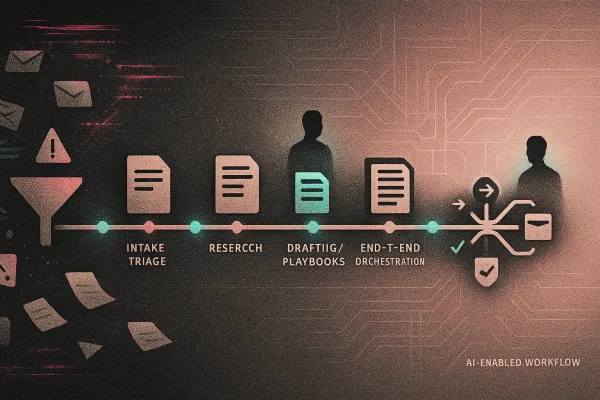
Legal Tech & Automation AI for Law Firms: Practical Workflows, Ethics, and Efficiency Gains Clients want faster turnaround and predictable bills, even as matter volume rises. This guide walks through concrete AI workflows for document review, research, and client intake—alongside the ethics guardrails that keep firms out of trouble.
Concepts in Tech for Lawyers How to Set Up Law Firm Subdomains with Cloudflare and DigitalOcean Running separate web properties for a law firm blog, client portal, or landing pages requires proper subdomain setup. This guide walks through DNS configuration with Cloudflare, DigitalOcean server setup, SSL certificates, and routing decisions for clean infrastructure.
Digital Presence & Online Policies Why Subdomains Matter for Modern Law Firms A subdomain is a prefix added to your firm's domain—like portal.yourfirm.com—that points to a separate application. For law firms, subdomains enable client portals, knowledge bases, and internal tools without compromising your main site's security or branding.
Startup Central The Cap Table as Legal Document: Beyond the Spreadsheet Investors treat your cap table as a legal document that must match signed agreements, board consents, and charter provisions. This guide covers how to reconcile equity records, fix common mismatches, and build an audit-ready cap table that survives diligence.
Legal Tech & Automation Open Source in Law: Why Law Firms Should Use It — and How to Do It Safely Most legal teams already rely on open-source software—just not consciously. It shows up inside cloud platforms, document tools, and AI services. This guide covers how to adopt it deliberately: license compliance, security vetting, and safe deployment patterns.
Business Formation & Corporate Governance Cap Table Management: A Startup Founder's Complete Guide Equity is a startup's core currency, and the cap table is its ledger. This guide covers initial setup, ongoing maintenance, SAFE and convertible note modeling, common mistakes that stall deals, and when counsel and cap table software must be part of the process.
Guides, Reviews & Commentary Decide If n8n Belongs in Your Automation Stack n8n is a node-based workflow automation tool that connects the apps you already use—email, CRMs, document storage, AI services—into repeatable pipelines. This evaluation covers whether it fits your firm's technical capacity and workflow needs.
Lawyer in the Loop Why AI Literacy Now Matters for Law Firms and Legal Teams In large enterprises, AI literacy is moving from specialist teams to the whole organization. Small and mid-size firms can't copy that playbook directly, but the underlying shift matters: your team needs to understand AI well enough to use it safely and effectively.
Legal Tech & Automation Why Legal Teams Are Looking at Open-Source Platforms Like Mattermost Legal teams are increasingly boxed in by cloud-only chat tools: rising per-user pricing, limited visibility into where data actually lives, and retention settings that don't map to professional obligations. Self-hosted platforms like Mattermost address those gaps.
Startup Central Carta Cap Tables: How Founders Avoid Legal and Diligence Problems Carta organizes your equity data, but it only reflects what you enter. This guide covers how to set up Carta with counsel from day one, avoid configuration mistakes, manage equity events, and audit your cap table before investors or buyers find gaps.
Legal Tech & Automation Law Firm Workflow Playbook: Automate Intake, Drafting, and Billing Small firms hit a ceiling when growth depends on manual work. This playbook covers how to map core workflows, automate intake and conflict checks, standardize drafting with templates and AI, and fix billing with automated reminders and lawyer approval gates.
Legal Tech & Automation Law Firm Workflow Automation: Intake, Drafting, and Billing Workflow automation helps small firms reduce manual intake, inconsistent drafting, and late billing without replacing legal judgment. This guide covers process mapping, lightweight tool selection, and implementing automations with built-in lawyer approval gates.
Development Journeys Integrating Code into Legal Practice: How a Lawyer–Developer Mindset Transforms Service for Tech Clients For most technology businesses, the product is software: APIs, data pipelines, and AI systems. That means core legal questions—IP ownership, data rights, compliance—require a lawyer who understands the code, not just the contract language around it.
Digital Presence & Online Policies Subdomains for Law Firms: Building Client Portals, AI Tools, and Internal Systems A subdomain is a section of your firm's domain—like portal.yourfirm.com—that points to a separate application. This guide covers architecture patterns for hosting client portals, AI-powered tools, and internal systems while maintaining security and control.
Legal Tech & Automation Why LLMs matter for legal work when designed around outcomes Many early AI pilots in legal stall for predictable reasons: models hallucinate, outputs sound confident but miss the point, or adoption collapses after the demo. The difference is outcome-driven design—building LLM integration around measurable legal results.
Legal Tech & Automation AI Workflows in Legal Practice: A Practical Transformation Guide Legal work is shifting from manual, email-driven practice to workflow-driven, AI-assisted operations. This transformation guide covers intake, extraction, triage, and review—with a framework for moving from scattered tools to connected workflows.
Startup Central Know What a “Healthy” Cap Table Actually Looks Like Investors evaluate cap-table health before writing checks. A healthy table shows balanced founder ownership, a properly sized option pool, and clean records. This guide defines what good looks like at each stage and flags common red flags.
AI Law Why AI and Web3 Demand a Different Kind of Lawyer (Practical Guide) Standard business lawyers often lack the technical fluency for AI and Web3 work. Token structures, training-data IP, and algorithmic accountability require counsel who can bridge law and technology. This guide explains what tech-fluent legal support looks like.
Tech Law DAO Legal Structure Explained: Liability, Tokens, and DAO LLCs A DAO without a legal entity exposes every member to personal liability. DAO LLCs and other wrappers give decentralized organizations the ability to hold assets and enter contracts. This guide covers formation options, governance, and regulatory considerations.
AI Law Start With a Human-First AI Strategy for Dealmaking AI tools compress M&A timelines by automating document review and flagging contract risks. But negotiation, relationships, and strategic decisions still need human judgment. This guide presents a framework for integrating AI into your deal process.
Legal Tech & Automation Legal Strategy, Quantified: Using Data and AI to Scale Risk Management Legal risk does not have to be a black box. By applying data and AI to contract analysis, compliance tracking, and litigation exposure, startups can quantify risk and allocate resources with the same rigor they apply to engineering or sales.
Legal Tech & Automation From AI Tools to AI Workflows: How Law Firms Can Actually Improve Margins Law firms face acute margin pressure: flat fees, client cost sensitivity, and tight talent pools. Buying point tools won't fix that unless workflows are redesigned. This piece maps how connected workflows across intake, research, and billing drive real returns.
Legal Tech & Automation Stop Buying Legal AI Tools. Start Designing Workflows That Save Money Firms and in-house legal teams face severe margin pressure, and buying point tools without defined workflows, governance, and human-review gates just adds cost without moving the needle. This guide reframes the approach around workflow design first.
Technology, AI, & Digital Innovation Featured Why Your Lawyer Must Actually Understand Technology (and What TRAIGA Gets Wrong) AI statutes land on top of running products, data pipelines, and engineering roadmaps. When a law like TRAIGA defines an 'automated decision system,' it maps onto real software—and lawyers who can't read that mapping create more risk than they manage.
Legal Tech & Automation Start with Outcomes — What ‘Good’ LLM Integration Looks Like in Legal LLMs have moved from experiments to line-of-business tools in law firms, legal departments, and legal-tech products. But many deployments stop at superficial chatbots. This framework starts with measurable outcomes and builds integration around them.