AI Law Drafting AI Disclosures for the 10-K: Materiality Without Hype Two-front pressure: 92 SEC comments / 56 companies push toward disclosure; AI-washing enforcement (Presto) punishes overstatement. Six-element Item 1A architecture, four-step pre-clearance workflow, integrated documentary spine.
AI Law AI BOM Disclosure: The OWASP and SPDX Standards for AI Procurement Two complementary AI BOM standards anchor 2026 procurement: OWASP AIBOM (six asset domains) and SPDX 3.0.1 AI Profile (machine-readable schema). California AB 2013 is the regulatory floor. Three implementation moves for procurement teams.
AI Law Lawful Training Corpus Warranties: Post-Bartz Rep & Warranty Drafting Bartz $1.5B + Kadrey caution = standard IP rep is not enough. Four-lane lawful-training-corpus warranty, AI BOM disclosure schedule, three indemnity calibration levers, three drafting fact patterns.
AI Law AI Diligence for M&A: The Workstream Most Buyers Aren't Running Yet AI diligence is now what cyber-DD was in 2018: a discrete M&A workstream that wasn't standard until the loss profile forced it. After Bartz $1.5B, Mobley, TRAIGA, and EU AI Act high-risk obligations, here is the buyer-side framework.
AI Law A 90-Day TRAIGA Compliance Plan for Texas Tech Companies TRAIGA takes effect Jan 1, 2026 with civil penalties up to $200K per violation. Section 546.103 makes substantial NIST AI RMF compliance an affirmative defense. A 90-day, four-phase workplan: Discovery, Governance, Vendor, Operationalization.
AI Law Roll-Up Acquirers and the AI Compliance-by-Design Question Roll-ups are repetitive by definition. Each acquired target imports its own AI exposure stack — shadow AI, pre-mid-2025 vendor reps, training-corpus gaps. Build compliance-by-design at the platform layer; phased Day 1-180 integration playbook.
AI Law The Marchand Test for AI Governance: What Boards Owe Their Shareholders Marchand creates heightened-scrutiny zone for mission-critical risk. Glass Lewis 2026 + CalPERS treat AI oversight gaps as director recall signals after material incidents. Six-artifact board record satisfies Marchand, TRAIGA, and Glass Lewis.
AI Law After McDonald's: Why Chief AI Officers Are Now Personally Liable for Oversight Failures In re McDonald's (Del. Ch. 2023) extended the Caremark oversight duty to corporate officers within their domain. With 60% of enterprises naming a CAIO, the named officer faces a personal-stakes posture that DGCL § 102(b)(7) does not cover.
AI Law EU AI Act August 2: A Pre-Deadline Checklist for U.S. Multinationals EU AI Act high-risk obligations apply 2 August 2026, with penalties up to 7% of worldwide turnover. Article 2(1)(c) reaches U.S. multinationals when AI output is used in the Union. A 10-item pre-deadline checklist for in-scope GCs and CAIOs.
AI Law The TRAIGA Safe Harbor: Why the NIST AI RMF Is Now a Business Decision TRAIGA went live January 1, 2026 with $200K-per-violation Texas AG enforcement and an affirmative defense for substantial NIST AI RMF compliance. That converts NIST adoption from a governance preference into a documented business decision.
AI Law Tech, Privacy, and AI Law: A Product Leader's Guide Most digital products are now data-driven by default — and increasingly AI-driven in ways that affect users in real time.
Startup Central When Copilot Committed the Ad: Agency Law, Electronic Signatures, and the Missing Duty-of-Care for AI Agents Moffatt v. Air Canada exports cleanly to US law: UETA Section 14 and Restatement Section 2.03 already bind the deployer. The drafting work is allocation, not attribution.
Lawyer in the Loop Audit-Ready AI-Assisted Law-Firm Workflows (FTC/FCC, Data Access, and Court/Ethics Disclosures) AI in law firms isn’t just a productivity upgrade anymore — it’s a supervision, confidentiality, and disclosure system.
AI Law AI for Law Practice: Professional Responsibility, Ethics & Compliance Guide for Lawyers The stakes are real. Tracked AI hallucination cases now number nearly 950 , with courts imposing sanctions ranging from fines to default judgment…
Technology, AI, & Digital Innovation You're Setting Yourself Up for Disappointment — Understanding AI Accuracy Across Text, Images, Audio, and Video What lawyers need to know about AI accuracy limitations across modalities. Practical guidance for setting realistic expectations and maintaining professional oversight.
Legal Tech & Automation Compliant AI Workflows for Law Firms: Ingesting U.S. Government Regulatory Data Without Scraping Regulatory data feeds (rulemaking, enforcement releases, filings, awards) are the raw material for client alerts, monitoring obligations, and faster…
AI Law Training Generative AI on Government Data: Legal Risks & Compliance Framework What follows is a builder-friendly compliance framework: a checklist for dataset intake decisions, plus minimum controls you can implement without…
Intellectual Property & Branding AI Training Data Compliance: A Practical Copyright & Fair-Use Playbook Weak training-data provenance can create injunction risk, derail enterprise diligence, and force expensive re-training. This guide covers fair-use posture, dataset governance, and the no-regrets controls every AI builder needs.
AI Law BitTorrent & AI Training Data: Copyright Risk and Audit-Ready Pipelines Table of contents Loading the Elevenlabs Text to Speech AudioNative Player... This guide is for AI startup founders, product leaders, in-house counsel, and tech-forward lawyers who are building models with scraped, third-party, or shadow-library-adjacent corpora. The practical problem isn’t only what’s in the
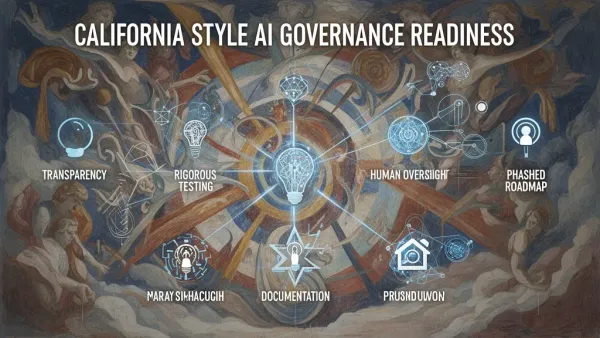
AI Law How to Get California-Ready for 2026 AI Laws California's 2026-era AI requirements are poised to become the de facto template for US state-level AI governance — especially for consumer-facing AI…
AI Law Two AI Developments Texas Lawyers Should Know About This Week Two things crossed my desk this week that signal where AI adoption is headed for Texas attorneys — one from the State Bar, one from a researcher trying to measure it.
AI Law AI for Law Practice: What Every Lawyer Must Know The gap between AI's promise and AI's performance in legal practice comes down to understanding what AI actually is, what it can reliably do, and how professional responsibility rules constrain its use.
AI Law U.S. Scraping Limits, API Access Controls, and National-Security Actions Are Reshaping AI Training Data Sourcing (and Fair Use) Federal enforcement, evolving case law, and national-security orders are tightening legal rules around AI training data. This guide covers scraping limits, API terms enforcement, copyright risks, and export-control issues for companies building or fine-tuning AI models.
AI Law Illinois’ 2026 AI Hiring Law and the New Federal Order: A Practical Dual-Track Compliance Playbook for Employers and Vendors If your recruiting stack uses resume scoring, chat-based screening, or video interview analysis, Illinois' next wave of AI hiring rules should be on your compliance calendar. This playbook covers dual-track obligations for employers and HR-tech vendors.
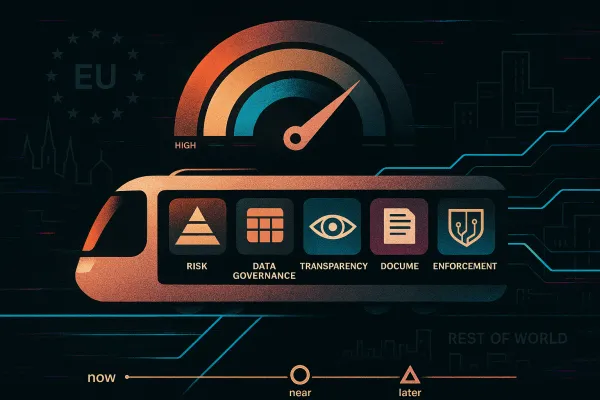
AI Law The EU AI Act Compliance Guide for Startups and AI Companies The EU AI Act introduces risk-based regulation for any startup serving EU users or enterprise customers. This guide covers risk tiers, prohibited practices, documentation requirements, and a timeline for building compliance into your product cycle.