
The Non-Negotiable Legal Basics for AI Startups
AI startups that skip foundational legal work face IP disputes, regulatory enforcement, and deal friction. This guide covers training-data rights, model ownership, privacy compliance, vendor contract terms, and lightweight governance frameworks every AI company needs.

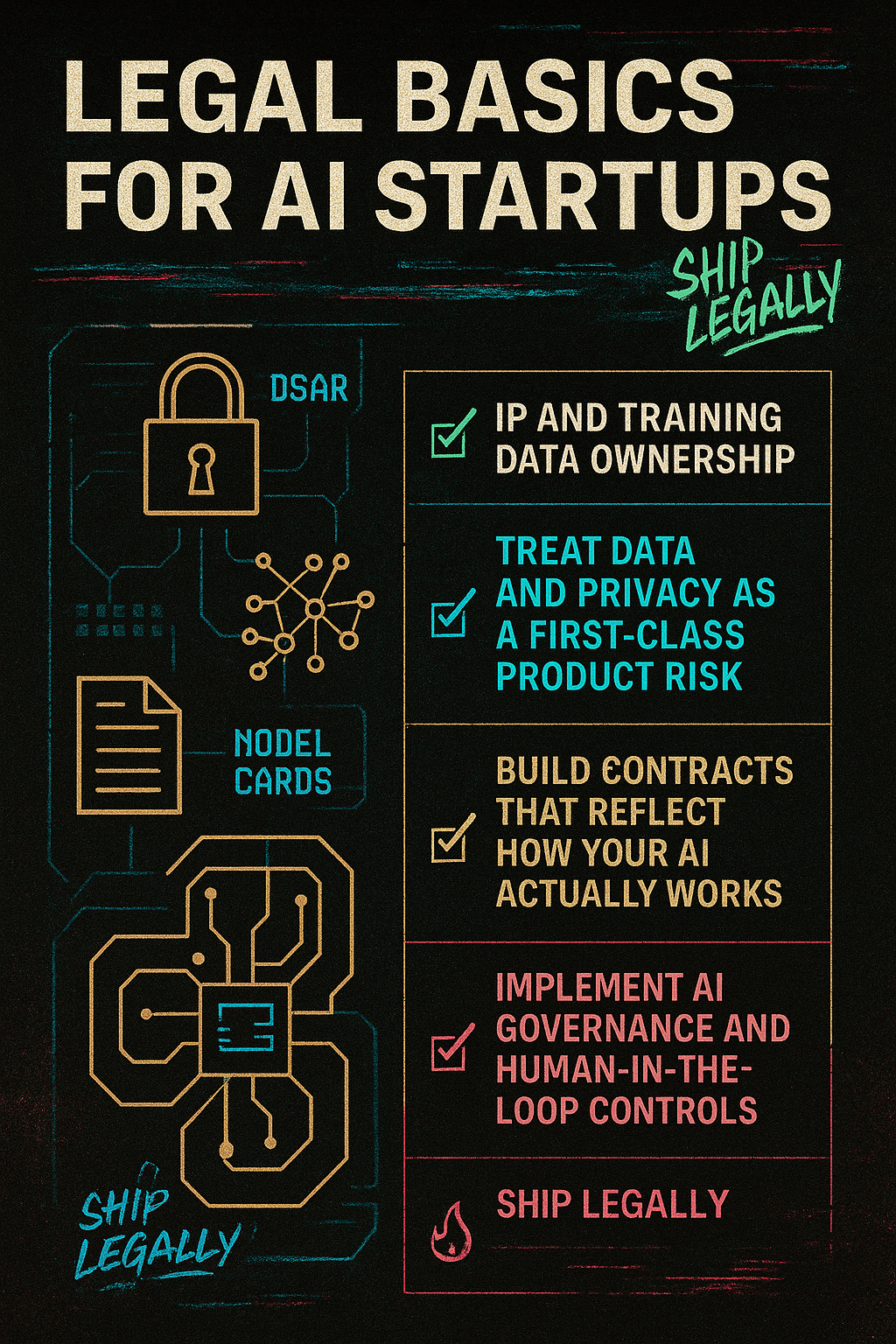
TL;DR — What Your AI Startup Needs in Place
Quick checklist: these are the legal basics that unlock fundraising, deals, and safer product shipping.
- Execute signed IP and invention‑assignment agreements for founders, employees, and contractors.
- Maintain a training‑data register: sources, licenses, consent flags, and retention limits.
- Update privacy notices and product UIs to disclose AI use; implement DSAR‑ready processes.
- Lock upstream vendor terms (no implicit training on prompts, data segregation, audit rights) and review open‑source model obligations — see open‑source model guidance.
- Add AI clauses to customer contracts: output ownership, disclaimers, and human‑in‑the‑loop obligations.
- Appoint an AI governance owner; keep model cards, versioning, and simple change approvals.
- Test for safety and bias, enable logging, and prepare a basic incident response playbook.
- Publish an internal AI use policy (no confidential data in public LLMs) and train staff.
- Create a one‑page AI risk assessment and a due‑diligence folder for investors/customers (see content‑generation risk analysis: legal risks of AI content).
Lock Down IP and Training Data Ownership Before You Ship
Why it matters. AI products bundle four distinct assets: source code/architecture, fine‑tuned weights, training datasets, and outputs. VCs and customers want clear title because ambiguity can block fundraising, kill deals, or create takedowns and infringement exposure.
Who owns what. Code and architecture should be assigned to the company; fine‑tuned weights are company assets if created under assigned engagements and with licensed data; datasets’ rights depend on source/license; outputs can carry third‑party claims — document permissions.
- Maintain a training‑data register: source, license/TOS, consent, and retention rule.
- Prefer licensed or customer‑provided data; avoid scraping or TOU violations.
- Require signed IP/invention‑assignment for employees, contractors, annotators (watch offshore shops).
- Audit open‑source model licenses for attribution or copyleft obligations.
Starter moves: deploy assignment templates, build a provenance log, review OSS use, and book counsel time. See Promise Legal’s writeup on legal risks of AI content and training data.
Treat Data and Privacy as First‑Class Product Risk
Map data flows. Separate user‑provided data, training ingest, evaluation sets, and inference inputs. Keep GDPR/CCPA basics clear for product teams: lawful basis, purpose limitation, data minimization, and subject rights.
Training on user data. Prefer explicit consent when using personal content to improve models; otherwise disclose the practice and offer an opt‑out. Failure to disclose (for example, training on customer chat logs) can trigger customer fallout and regulatory scrutiny — see Promise Legal’s note on AI digital assistant privacy risks.
Practical steps:
- Create a data map and classify PII/sensitive and regulated data.
- Segment production vs training environments; restrict raw‑log access and retain minimal fields.
- Update privacy notices and in‑product disclosures; implement DSAR lookup/delete procedures.
- Review DPAs and vendor settings (disable training by default); address cross‑border transfers and retention rules.
Sample privacy snippet: “We may use de‑identified or consented user content to improve our models. You can opt‑out of model training in account settings.”
This quarter (quick wins): complete a data inventory; update privacy policy with AI disclosures; review DPAs; disable vendor API training by default; test a DSAR deletion; set retention limits.
Build Contracts That Reflect How Your AI Actually Works
Know your place in the stack. Upstream model/API providers, infra vendors, your fine‑tuned models, your SaaS layer, and customers each carry different rights and risks. Contracts must align so you don’t promise protections you cannot deliver.
- Negotiate key vendor clauses: ownership of outputs, prohibition on training on customer prompts, data segregation, SLAs, security certifications, audit rights, indemnities, and sensible liability caps.
- Best practices: require vendors to disable training on prompts by default and to obtain explicit consent for any secondary use of customer data.
- DPAs & data: update processor agreements and data flow terms early — start with a reliable template like Promise Legal’s DPA template.
Customer terms: clearly state capabilities and limits, add AI output disclaimers, require human‑in‑the‑loop for high‑stakes features, and include acceptable‑use prohibitions (deepfakes, harassment, illegal uses).
Sample clauses (brief):
Output disclaimer: “Company provides AI outputs as‑is; Customer shall verify results and Company disclaims accuracy warranties.”
HITL obligation: “Customer will implement human review before relying on outputs for legal, medical, or financial decisions.”
Hygiene checklist: audit upstream terms, align customer promises with vendor rights, add AI sections to MSAs/ToS, and update DPAs.
Stay Ahead of AI Regulation Without Boiling the Ocean
Focus on what matters. Start with consumer‑protection (FTC and equivalents), sector rules (health, finance, employment, education), and the EU AI Act’s risk‑based approach that can reach products used in the EU. For practical reading, see Navigating the Patchwork: State‑by‑State AI Laws and Intersections of Tech Law, Privacy, and AI Law.
Translate doctrine into concrete steps:
- Inventory AI use cases: note where models influence decisions and what data is used.
- Classify use cases by risk (low/medium/high) based on impact to people’s rights or opportunities.
- For high‑risk features, complete a short AI impact assessment (purpose, inputs, testing, mitigations, owner).
Avoid enforcement magnets: don’t overclaim capabilities, avoid dark patterns for consent/disclosure, and clearly label AI interactions where required.
Quick compliance to‑dos: draft a one‑page AI risk policy and assign an owner; document one risk assessment for your riskiest feature; align marketing with reality; and monitor regulatory updates in your target markets.
Implement Lightweight AI Governance and Human‑in‑the‑Loop Controls
Why it matters. Even 5–20 person startups get faster sales and easier diligence with simple, documented governance: fewer incidents, clearer risk allocation, and predictable releases.
Roles & decision‑making. Appoint an AI governance owner or small cross‑functional group (product, engineering, legal). Define who approves new models/features, who can change prompts/system instructions, and who signs off on higher‑risk deployments.
HITL & lawyer‑in‑the‑loop. Specify which outputs require human review (employment screening, credit, medical or legal‑advice‑like outputs). Use a lawyer‑in‑the‑loop for legal/regulatory judgments — see Promise Legal’s guidance on legal workflows with AI: Intelligence Lawyer.
Documentation & change control. Keep short model cards (purpose, inputs, training summary, limits, evaluation results); version models/prompts; run pre‑deploy safety checks; log key decisions and incidents.
- Appoint owner and assign risk levels.
- Define HITL boundaries and escalation paths.
- Create a one‑page AI system register and simple change log.
- Integrate governance with security and incident response.
For an operational playbook, see the complete governance guide: Complete AI Governance Playbook (2025).
Manage Product Safety, Bias, and Liability Risk Up Front
Understand the harms. Hallucinations, stale or incorrect facts, biased or discriminatory outputs, harmful content, and unsafe recommendations create real consumer and commercial harm — from SLA breaches and tort exposure to regulatory and reputational fallout.
Test like your users depend on it. Build realistic domain test sets, measure accuracy/robustness and disparate impact across key groups, and run red‑teaming or adversarial checks scaled to your risk profile.
Mitigate in product. Surface warnings and confidence indicators, require confirmations or escalation for high‑risk actions, and provide an easy “report problematic output” flow.
Prepare for incidents. Define an “AI incident,” then follow a playbook: contain → assess impact → notify affected users/customers → remediate and log. Involve counsel early and discuss tech E&O/cyber insurance with your broker.
Quick checklist: pre‑launch testing regime; comprehensive logging/retention; user‑facing warnings/HITL; incident runbook; insurer conversation.
For governance and lawyer‑in‑the‑loop patterns, see Promise Legal’s practical guidance: The Inevitable Convergence of Law & Technology.
Get Your Team, Contractors, and AI Tooling on Secure Legal Footing
Employment & contractor IP. Require signed invention‑assignment and confidentiality agreements for founders, employees, contractors, advisors, and pilot customers. Explicitly assign rights in code, models, fine‑tuned weights, datasets, and annotations.
Data workers & annotators. Ensure vendor contracts include work‑for‑hire or IP assignment, confidentiality, security obligations, and a warranty about rights in source material. With offshore vendors, confirm data transfer rules, local law risks, and audit rights.
Employee use of external AI tools. Ban or tightly restrict pasting confidential code/data into public LLMs. Publish a short internal AI use policy that lists approved tools, prohibited uses (no customer PII or proprietary source in public prompts), and escalation paths; train staff and enforce via access controls.
Examples & quick wins. A contractor claiming model ownership or a developer leaking customer data into a chat UI are common — both prevented by clear assignments, NDAs, and a brief AI‑use SOP. For lawyer‑in‑the‑loop patterns and operational templates, see Promise Legal’s guidance: Lawyer‑in‑the‑Loop and AI use policy playbook.
- Checklist: deploy assignment & NDA templates; review labeling/vendor agreements for IP & security; publish internal AI use policy; run staff training; standardize onboarding/offboarding access.
Consolidated Legal Checklist for AI Startups
Use this condensed task list for internal planning and due diligence. Assign owners and deadlines for each line item.
- IP & data: execute IP/invention assignments for all contributors; log training datasets and licenses; document model/weights ownership and audit open‑source licenses.
- Privacy: create a data map; update your privacy notice to disclose AI/training uses; implement DSAR deletion; disable vendor API training by default; set retention rules.
- Contracts & vendors: review upstream terms; insist on no‑training/data‑segregation, security, audit rights; update MSAs/DPAs and align marketing claims.
- Governance & compliance: appoint an AI owner; define HITL for high‑risk features; perform one AI risk assessment; enable logging and an incident playbook; monitor EU AI Act/FTC guidance (state‑by‑state AI laws).
- Team & culture: publish an internal AI use policy; train staff on IP/privacy basics; standardize onboarding/offboarding; audit labeling vendors and contractors.
Start here: assign owners for IP assignments, a data inventory, and a privacy‑notice update. For templates and operational patterns, see Promise Legal’s lawyer‑in‑the‑loop guidance.
Actionable Next Steps for AI Startup Founders
Act now — it’s cheaper and faster. Fixing IP, data, and governance issues later costs more and slows fundraising, partnerships, and sales. Below are prioritized, owner‑assignable steps to make real progress quickly.
- Within 30 days: execute IP/invention‑assignment agreements for all contributors; inventory training data sources and licenses; update or draft a privacy notice that discloses AI uses and training practices.
- Within 60 days: review upstream AI vendor contracts (no‑training/data segregation, security); add AI disclaimers and human‑in‑the‑loop obligations to customer terms; appoint an AI governance owner and create a one‑page AI system register.
- Within 90 days: run a focused AI risk/impact assessment for your highest‑risk feature; implement logging and an incident response playbook; roll out an internal AI‑use policy and staff training.
Need help tailoring this plan? Use the checklist with your product and legal teams — or contact Promise Legal for templates and a tailored roadmap: https://promise.legal/contact. For operational patterns like lawyer‑in‑the‑loop, see our guide: https://blog.promise.legal/what-is-lawyer-in-the-loop/.