
The Consultant’s Legal Checklist: Formation, Contracts, IP & Risk Management (With Service Agreement Tips)
Many consultants launch with DIY documents and face disputes over scope, fees, and IP ownership. This checklist provides steps for entity formation, MSA and SOW design, IP carve-outs, data compliance, liability caps, and insurance alignment.

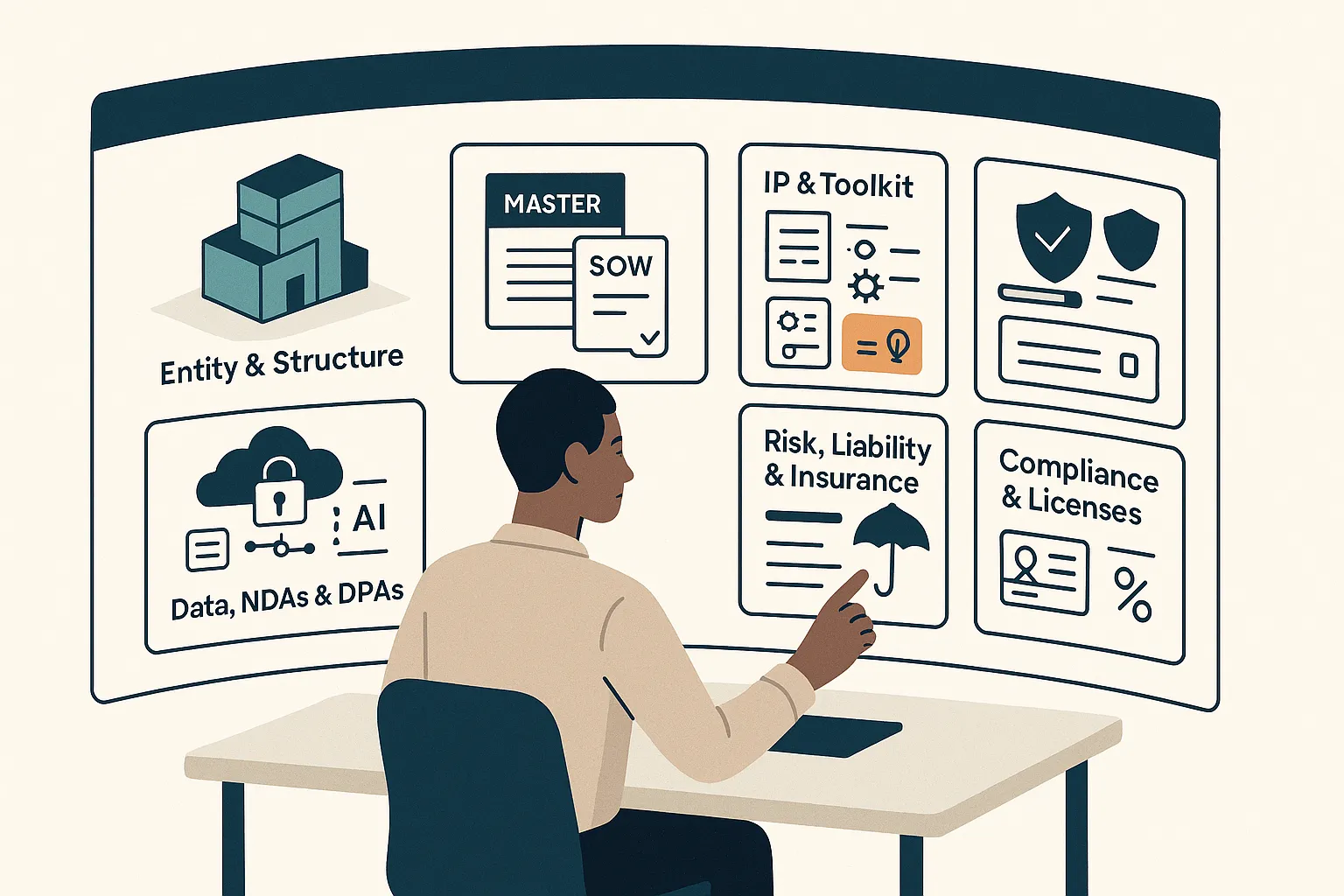
Many consultants launch with DIY documents and no legal support — and then end up in disputes over scope, unpaid fees, unclear ownership of deliverables, and unexpected personal liability. This practical checklist is for solo consultants and small consulting firms who want to launch or scale with a solid legal foundation. You’ll get clear, actionable steps on entity formation, compliance, contract and SOW design, IP carve‑outs, and risk management (insurance, liability caps, dispute paths), plus example clauses and prioritized next steps. If you want to start with contracts, see our service agreement walkthrough and sample templates: How to Write a Service Agreement and Advisor/Consulting Agreement Templates.
TL;DR — Your Essential Legal Checklist for a Consulting Business
Use this as a quick roadmap—see the sections below for details.
- Form the right entity (often an LLC); register DBAs.
- Get registrations: EIN, state tax/sales (if applicable), and local or professional licenses.
- Create a master service agreement and reusable SOW templates — see an advisor template.
- Clarify IP: client deliverables vs. your reusable toolkit; carve‑outs for pre‑existing materials.
- Use NDAs and DPAs for client data and AI tools.
- Build contract protections: liability caps, indemnities, termination, and change‑orders.
- Match contracts with insurance (E&O) and a dispute‑resolution plan.
Read the full guide for example clauses and next steps; consult a lawyer to tailor this checklist to your practice.
Start With the Right Business Structure and Setup
Your entity choice affects liability, taxes, and client credibility—get it right early to avoid personal exposure and tax surprises.
- Sole proprietor — simplest; no liability shield; ok only for very‑low‑risk, side‑gig work.
- Single‑member LLC — the common consultant default: limited liability and flexible tax treatment; document it with an operating agreement.
- S‑corp election — can lower self‑employment taxes once revenue is material, but requires payroll, a reasonable salary, and CPA + lawyer coordination.
Mini‑scenario: a sole‑prop strategy consultant is sued over alleged bad advice — personal assets become exposed.
- Register your business name/DBA; obtain an EIN and any state/local tax or sales registrations.
- Prepare an operating agreement and simple governance (bank resolution, basic minutes) even for single‑member LLCs.
Bring a lawyer for entity selection, multistate filings, and drafting governing documents (articles, operating agreement/bylaws, initial resolutions). For contract guidance and reusable templates, see our service agreement guide: How to Write a Service Agreement and sample advisor/consultant template: Advisor Agreement Template.
Stay Compliant as You Grow: Licenses, Taxes, and Data Handling
Consulting often feels low‑regulation, but you still face legal obligations that scale with your clients and the data you touch. Key compliance areas:
- Local business licenses and permits (city/county).
- State tax registrations and sales‑tax rules (know where your services are taxable).
- Professional licenses/certifications when applicable (e.g., finance, healthcare).
- Employment vs. contractor classification if you hire subcontractors.
Data & privacy basics: protect client confidential information, trade secrets, and personal data; control use of cloud and AI tools and include clear data‑processing/DPA terms in contracts. Mini‑scenario: a marketing analytics consultant uploads raw customer data into a public AI tool without client consent — risking privacy violations and contract breaches.
Legal help maps obligations to your services, drafts DPAs and privacy clauses, and advises safe data‑sharing and tool‑use policies. See our guides on data law and AI legal issues: The Role of a Data Lawyer and AI Legal Issues.
Make Your Consulting Contracts Work for You, Not Against You
Contracts are your primary legal tool—most disputes arise from unclear scope, late payment, IP ownership, or missed timelines. Use a master service agreement plus project SOWs so each engagement spells out deliverables, responsibilities, and change‑order processes.
Core Clauses Every Consulting Agreement Should Cover
- Scope of services & SOW reference
- Timelines, dependencies & client responsibilities
- Fees, payment terms & remedies for late/non‑payment
- IP ownership, assignments & license‑backs
- Confidentiality & data security
- Warranties & disclaimers (no guarantees)
- Limitation of liability & indemnity
- Term, termination & offboarding/hand‑over
Mini‑checklist before signing: Is scope explicit? Are fees/milestones clear? Who owns deliverables vs. reusable IP? Are liability caps and termination rights reasonable?
Example Clauses (examples only)
Scope: “Services are limited to those described in the applicable SOW. Any changes require a written change order and will be billed at the agreed rates.”
Limitation of liability: “Except for gross negligence or willful misconduct, each party’s aggregate liability is limited to the fees paid under the applicable SOW in the prior 12 months; neither party will be liable for consequential damages.”
Want reusable templates and drafting help? See our guides: How to Write a Service Agreement and Master Service Agreements. A lawyer can tailor a master agreement + SOW framework to your niche and risk tolerance.
Protect the IP That Powers Your Consulting Practice
“IP” for consultants means frameworks, templates, decks, playbooks, training materials, code/tools, and brand—your repeatable assets. Separate client‑specific deliverables (what clients should own) from your underlying methods and toolkits (what you must retain).
Getting IP Ownership Right
Define “Deliverables” vs “Pre‑existing Materials.” Clients often expect deliverable assignments; preserve carve‑outs or a license‑back for pre‑existing content, templates and know‑how. Avoid blanket assignments and be cautious with “work‑for‑hire.” Mini‑scenario: an AI strategy consultant passed a proprietary playbook without carve‑outs; the client later claimed exclusive rights and blocked reuse.
Branding & Trademarks
Register trademarks when you productize names or frameworks and perform clearance checks. See Promise Legal’s trademark guide: https://blog.promise.legal/startup-central/what-is-a-trademark-class-how-many-are-there-and-why-they-are-important/. A lawyer can craft IP clauses that let you scale and reuse your toolkit.
Use Contracts and Insurance Together to Manage Risk
Contracts define who pays for what; insurance pays covered losses. Make them align: don’t contractually promise indemnities or coverage that your policy excludes, and set liability caps that reflect realistic policy limits.
Contractual Risk Controls to Prioritize
- Limitation of liability caps and explicit exclusions
- Mutual, narrowly‑tailored indemnities where needed
- Disclaimers about results and reliance on client data
- Allocation of regulatory/compliance and data‑security responsibilities
- Dispute resolution: negotiation/mediation, governing law and venue
Insurance Basics for Consultants
- Professional liability / errors & omissions (E&O)
- General liability and cyber/privacy endorsements where relevant
- Enterprise clients may require a Certificate of Insurance and specific limits/endorsements
Mini‑scenario: A marketing consultant sued over an alleged campaign shortfall — a reasonable liability cap plus E&O helps contain defense costs and exposure. Have a lawyer compare your contracts and insurance to spot gaps and avoid promises your insurer won’t cover. For contract drafting and cyber guidance, see our service agreement guide: How to Write a Service Agreement and Building a Culture of Cybersecurity.
Common Pitfalls for Consultants Who Skip Legal Help
Skipping legal setup creates predictable, costly problems.
- Sole proprietor: a client claim can reach personal assets — form an LLC and keep finances separate.
- Generic templates: missing clauses on IP, data or payments create exposure — use a tailored master service agreement + SOWs (how to write a service agreement).
- Giving away IP: lose the right to reuse frameworks — carve out pre‑existing materials and include license‑backs.
- No change‑order/termination rules: scope creep and unpaid work — require written change orders and payment milestones.
- Ignoring local compliance: fines, tax surprises or contract problems — audit licenses, sales‑tax and data obligations early.
Early legal setup is cheaper than litigation or rework.
FAQs: Straight Answers to Consultants’ Top Legal Questions
Q1 — Do I really need an LLC? Not always, but an LLC is the common default: it separates personal assets, adds client credibility, and simplifies contracts. Discuss S‑corp tax elections with a CPA.
Q2 — Can I just use a generic template? Risky. Generic templates often miss IP, data and liability protections; use a master service agreement + SOW tailored to your work (see our guide: How to Write a Service Agreement).
Q3 — Who owns the IP? It depends on contract language: clients typically get client‑specific deliverables, while you should carve out pre‑existing materials and seek license‑backs for reusable tools.
Q4 — What insurance do I need? Start with professional liability/E&O; add general liability or cyber coverage as appropriate. Match policy limits to contract caps; many clients will request a Certificate of Insurance.
Q5 — When to bring in a lawyer? Early — entity choice, a reusable agreement/SOW and IP carve‑outs avoid common traps; revisit contracts before enterprise deals or growth inflection points.
Actionable Next Steps for Your Consulting Business
Legal infrastructure is a growth asset, not just a cost. Prioritize these steps now:
- Choose an entity. Work with a CPA and lawyer to form an LLC (or other) and adopt an operating agreement. LLC guidance.
- Standardize contracts. Adopt a master service agreement + SOWs; audit scope, fees, IP carve‑outs, liability caps and termination. Service agreement guide.
- Inventory IP & brand. Preserve reusable frameworks with carve‑outs or license‑backs; consider trademark basics. Trademark basics.
- Map compliance & data handling. Add DPAs and AI‑tool limits. Data lawyer guide.
- Align insurance. Talk to a broker about E&O and match policy limits with contract caps.
Need help building a consulting legal toolkit? Contact Promise Legal — early legal work speeds growth and reduces risk.