
Licensing Your Characters to Generative AI Platforms: A Legal & Governance Checklist for Studios and AI Companies
Generative AI platforms want to use characters and likenesses in ways traditional licensing never anticipated. Rights holders need contracts addressing training-data use, output ownership, quality control, and takedown rights. This checklist covers the key terms.

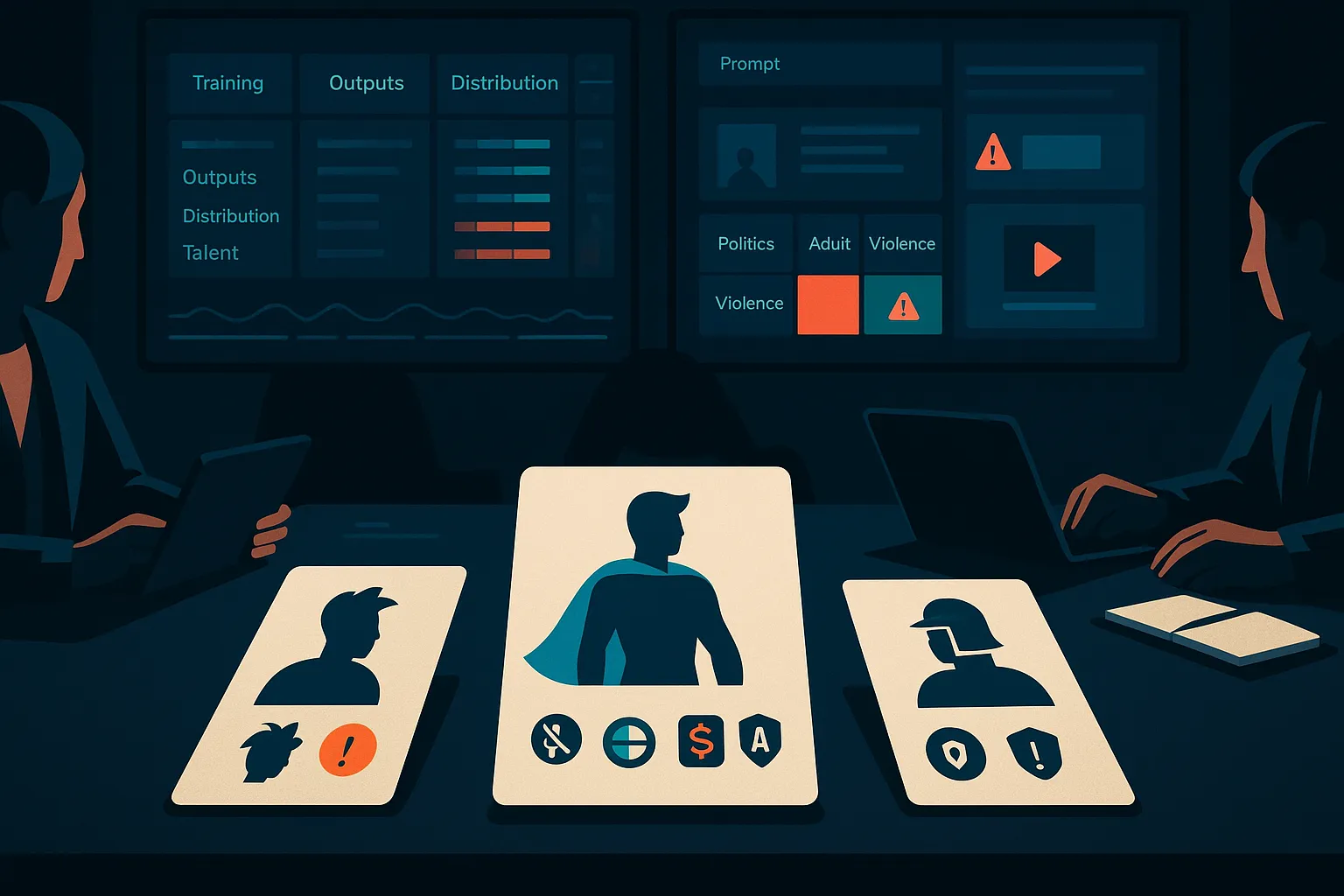
The Disney-OpenAI moment — reported multi‑character licensing plus a major platform tie‑in — has shifted generative character work from niche experiments to mainstream product strategy. Fan prompts now generate high‑fidelity, on‑brand clips at scale; some will remain on the app, others will be exported, remixed, or curated onto large streaming channels.
The core tension is simple but sharp: fans want playful mashups and expressive tools; rights‑holders fear loss of control, brand dilution, reputational harm, and copyright/right‑of‑publicity exposure; and platforms need broad training and reuse rights to build economically viable models. Without precise contracts and enforceable product controls, liability and PR risks cascade across studios, platforms, and creators.
This guide is aimed at studio and rights‑holder executives, game and animation publishers, character‑based startups, AI product leads, and their counsel. It’s a pragmatic playbook — not an academic paper — with a focused due‑diligence checklist, example deal patterns, and operational governance steps to reduce legal, brand, and talent risk.
Expect concrete contract language to negotiate, product specs to operationalize safety, and a governance roadmap you can adapt. For operational templates and deeper governance guidance, see our AI governance playbook, and for training vs output nuance see our writeup on AI training and fair use.
Start With a Clear Map of What You Actually Control
Rights mapping is step one: you can’t license what you don’t own or control. Character rights are routinely fragmented across copyright, trademark/trade‑dress, performer/likeness rights, and third‑party contracts — so do a pre‑deal inventory.
- Copyright: designs, scripts, music, settings.
- Trademark/trade dress: names, logos, costumes.
- Right of publicity: actors, motion‑capture, voices.
- Contractual limits: guild/talent clauses, co‑producer/sponsor consents.
Example: a studio licenses a character but misses a voice actor’s clause banning synthetic voices; the platform’s use could breach talent contracts and prompt injunctions and reputational damage.
Pre‑negotiation checklist:
- Which characters/franchises are in‑scope?
- Territory, language, and channel limits?
- Media carve‑outs (games, ads, political, adult)?
- Which third parties need consent or notice?
Tip: maintain a structured rights registry with AI‑use flags tied to product gating. For training vs output nuance see Promise Legal’s deep dive.
Share the registry with product, trust & safety and licensing teams; tag characters with red‑lines (e.g., “no synthetic voice,” “no political use”) so engineering can enforce rules in the UI.
Decide What You’re Really Licensing: Training, Outputs, or Both?
Think of three separate permissions: (1) training/data ingestion (teach the model a character’s style/motion/voice), (2) runtime generation (permit the model to produce new clips that visibly use the character), and (3) UI/branding uses that display marks or themed assets without embedding the IP into model weights.
The law on training models with copyrighted works remains unsettled, so parties usually negotiate training as a commercial right rather than rely on a unilateral fair‑use argument.
Example risk: a platform trains on licensed character art then repurposes the tuned model in a separate app. Prevent this with clauses restricting reuse, requiring model segregation, and prohibiting cross‑client deployment.
Contract checklist:
- Training: allowed sources, model segregation, retention/deletion, provenance logs.
- Output: permitted formats, length/ratings, banned contexts (ads, political, adult) and approval triggers for curated/monetized uses.
- Retention/reuse: post‑term deletion or escrow, prohibition on using tuned weights for others.
- Exclusivity: granular by character, channel, territory and duration.
Operational tip: separate training licenses from output/exploitation licenses so you can renegotiate or terminate one without collapsing the other.
Build Guardrails Around Fan Prompts and Brand Safety
When fans can prompt generative video with beloved characters, edge cases follow fast: violence, hate, political messaging, sexualization of minors, and misinformation can all appear under a studio’s brand. Left unchecked, these cause legal, regulatory, and reputational harm.
Two complementary controls: platform‑side safety (model filters, prompt classifiers, automated output checks, moderation workflows) and IP‑holder content rules (brand do‑not‑do lists, age‑rating limits, contextual bans).
Example: a child character forced into a political endorsement — the studio’s license should both prohibit political uses and require the platform to block relevant keywords, prevent export, and apply emergency takedowns.
Contract & Product Checklist
- Prohibited categories: politics, sexual/minor sexualization, hate, medical disinformation, impersonation.
- Technical controls: prompt blocklists, output classifiers, model/version gating, UI warnings.
- Review/escalation: human review thresholds and party‑responsibility table.
- Takedown SLA: expedited removal + downstream notice and evidence logging.
- Transparency: visible AI labels and “not official” disclaimers.
Governance tip: build a joint brand‑safety matrix (sample prompts → allowed / needs review / prohibited) and embed it as a license exhibit so product, legal and T&S teams share an auditable rulebook. For operational governance templates see Promise Legal’s playbook.
Monetization, Credit, and Fan Participation Without Exploitation
Generative character features can drive engagement and create scalable content pipelines — but they also raise tricky rights, reward, and reputational questions. Decide early whether you want to incentivize creators, treat outputs as platform / studio content, or adopt a hybrid approach.
- Key questions: Will creators be paid or credited? Who owns outputs (user, platform, studio)? When does monetization trigger studio share or approval?
Example: a fan’s prompt spawns a viral mini‑series; the platform includes clips in a paid anthology without creator credit or clear studio approval — reputation and legal risk spike fast.
Contract & Product Checklist
- User terms: plain‑language ownership and license‑back clauses (prompt vs output).
- Revenue: define triggers (curation, export, ads), splits, payment timing, and reporting/audit rights.
- Attribution: mandatory UI credits, promotional disclaimers, and limits on implying official canon.
- Data use: opt‑in/opt‑out for training; logging for payout/claims.
Practical tip: involve marketing, community and T&S when designing rewards and visibility rules so monetization aligns with brand values and avoids exploitation. For legal framing on user intent and copyright, see Promise Legal’s piece on AI, copyright and user intent.
Allocate Legal Risk: Infringement, Deepfakes, and Indemnities
Generative character outputs create layered legal exposure: copyright/derivative‑work risk (notably crossovers), trademark dilution/tarnishment, right‑of‑publicity/voice misuse, and defamation/privacy/deepfake harms when real people are implicated or confused with AI outputs.
Example: a user prompts a licensed sci‑fi hero into a compromising scene with an unlicensed celebrity — the celebrity sues. Who defends, pays, or injuncts depends on reps, indemnities and available evidence.
Contract & risk checklist
- Reps & warranties: studio warrants chain‑of‑title and talent consents; platform warrants safety controls and compliance.
- Indemnities: carve by claim type (title/talent vs moderation failures); require defense and payment for third‑party claims.
- Insurance: require media/tech E&O and cyber policies with minimum limits and notice duties.
- Audit & cooperation: defined access to prompts, outputs, model version, and retention logs; cooperation SLA for investigations.
- Termination & remedies: injunctive relief, emergency geo‑blocks, and termination triggers for regulatory or litigation escalations.
Operational note: build an incident response playbook (PR + legal + product + T&S) with takedown, evidence‑preservation, and fast rollback mechanics. For governance and legal templates see Promise Legal’s AI governance playbook and AI legal guide (or this version of AI governance guidance aimed at attorneys).
Design Governance: Who Approves What, and How Often?
Generative AI character programs require continuous governance — not periodic contract sign‑offs. Build a lightweight but authoritative structure that translates legal limits into product checkpoints and measurable metrics.
Practical governance setup
- Joint steering committee: legal, product, trust & safety, brand/marketing and an operations owner from the platform — convene for sign‑offs and escalations.
- Approval workflows: require written notice and approval for major changes (model version, new prompt templates, export/monetization channels) plus pre‑deployment safety testing and rollback plans.
- Metrics & monitoring: track takedown volume, safety filter hit rates, false negatives, user complaints and regulatory inquiries; publish quarterly scorecards.
Governance checklist
- Change‑control clause with notice windows and veto or expedited review.
- Quarterly reviews of hotspot metrics and adjustment of rights/filters.
- Retain logs (prompts, outputs, model version, moderation decisions) for defensibility.
- Integrate with the company’s AI risk/oversight committee and incident playbooks.
For operational templates and legal framing, see Promise Legal’s AI governance playbook and training/output deep dive: AI Governance Playbook and Training vs. Output.
Example Deal Patterns: What Different Players Should Optimize For
Below are three compact archetypes and the practical tradeoffs each should prioritize when negotiating character AI deals.
Major studio / franchise owner
- Primary objectives: preserve brand integrity and long‑term IP value; strong approval and veto rights.
- Non‑negotiables: no political/sexual/child exploitation uses; performer consent for synthetic voice; emergency injunctive remedies.
- Where to compromise: limited non‑exclusive social snippets, co‑marketing, fixed rev share for curated placements.
Mid‑size game or animation studio
- Primary objectives: audience growth and experimentation; balanced monetization.
- Non‑negotiables: key brand red‑lines and talent constraints.
- Where to compromise: broader runtimes or geography for revenue share and marketing support.
AI platform / startup
- Primary objectives: reusable rights, scalable safety, and model portability.
- Non‑negotiables: allowable reuse of tuned models only with consent; practical moderation SLAs.
- Where to compromise: time‑limited exclusives, narrower channels, or higher fees for guaranteed governance.
Cross‑border note: EU/UK/US differ on copyright, personality rights and liability — build territory‑aware scopes and change control. When child characters, real performers, or international streaming are involved, engage specialized AI/IP counsel and tie governance into your operational playbook (see Promise Legal’s governance and training resources: AI Governance Playbook and training vs. output deep dive).
Actionable Next Steps
Turn this guide into a prioritized 30–90 day plan. Start small, document everything, and reduce surface area for legal and brand harm.
- Inventory IP touchpoints. Catalog every product flow, template, or UGC surface that invokes third‑party IP and flag any “shadow licensing” assumptions.
- Map rights buckets. For each character integration, document training, generation and distribution rights plus territory and channel limits.
- Set risk appetite & policies. Define banned categories, update ToS/prompt policies, and publish plain‑language guidance for creators.
- Operationalize moderation. Establish filter targets, retention/logging, human‑review triggers, and SLAs (e.g., 24‑hour emergency takedowns).
- Stand up governance. Create a cross‑functional review body with pre‑launch sign‑offs, quarterly hotspot reviews, and change‑control rules.
- Get counsel involved. Have specialized AI/IP lawyers review term sheets, indemnities, model reuse and talent/union constraints before multi‑year grants.
Need help? Contact Promise Legal for term‑sheet reviews, AI product & IP risk assessments, and governance design. For operational templates see our AI Governance Playbook.