
How to Get California-Ready for 2026 AI Laws
California's 2026-era AI requirements are poised to become the de facto template for US state-level AI governance — especially for consumer-facing AI…

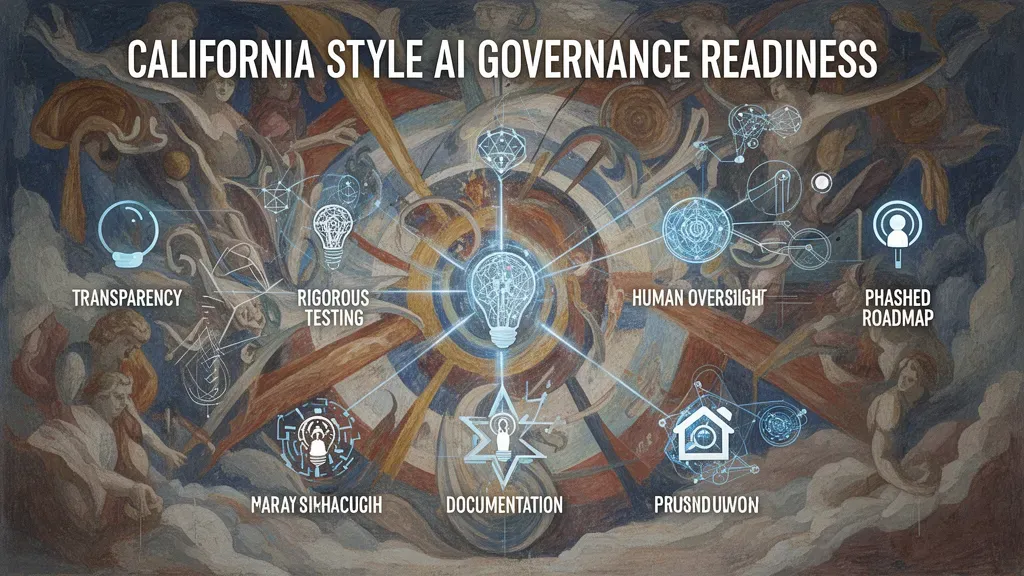
California’s 2026-era AI requirements are poised to become the de facto template for US state-level AI governance — especially for consumer-facing AI and systems that influence consequential decisions. Even if your company isn’t “based in California,” selling or providing AI-enabled services to California users (or enterprise customers with California footprints) can pull you into CA-driven diligence and contract demands.
This is a practical implementation guide, not a legislative recap. The goal is to translate likely California expectations (disclosures, testing, human oversight, and documentation) into concrete product decisions and operating workflows that won’t collapse under customer questionnaires or a regulator’s request for evidence.
It’s written for AI startups, product and engineering leaders, in-house counsel, and law firms/legal-tech teams building or deploying AI tools that reach California.
The risk of waiting is predictable: last-minute compliance scrambling, blocked launches (or delayed enterprise procurement), and painful renegotiations when customers demand AI audit materials, change notices, and safety representations.
Below is a staged checklist you can run in parallel with product development — covering disclosures, risk assessment, “human-in-the-loop” controls (including lawyer-in-the-loop patterns), contracts, and governance.
Understand Where California’s 2026 AI Rules Actually Touch Your Business
Assume California touches you if you develop, deploy, or market AI features used by California residents or businesses — or if you sell AI infrastructure into California companies that will demand compliance evidence. With multiple 2026-effective laws (for example, AB 2013 and SB 942 both effective Jan 1, 2026), “we follow the law” won’t satisfy procurement or regulators; you’ll need specific controls around transparency, testing, and oversight.
Map your AI use-cases
- Customer-facing assistants (chat, summaries, recommendations)
- Decision support for staff (risk scoring, triage, prioritization)
- Automated/consequential decisions (hiring, credit, housing, eligibility)
- Internal legal/compliance tools (contract review, investigations, policy drafting)
Example: A SaaS startup sells an AI contract summarizer to law firms nationwide. Even if the startup has no CA office, CA users (and CA-based clients of those firms) can drive: disclosure requests, procurement addenda, and “show me your testing” demands.
Quick scoping questions
- Do you have California users, customers, or end-beneficiaries?
- Can the AI materially influence decisions with real-world harm if wrong or biased?
- Do you (or vendors) market claims like safe, reliable, fair, or “more accurate than humans”?
- Mini-checklist (yes/no): (1) Any CA users? (2) Any GenAI output shown to users? (3) Any ranking/scoring of people? (4) Any AI used in regulated contexts (employment/credit/health)? (5) Any enterprise customers asking for AI addenda? (6) Any third-party models in your stack? (7) Any public claims about safety/fairness?
Turn California’s Transparency Expectations into Concrete Disclosures
California’s 2026 AI laws point toward one practical reality: users (and customers) should be able to tell when they’re seeing or relying on AI outputs. That’s not just good UX; it reduces deception risk and aligns with CA’s transparency push (including SB 942’s “AI detection tool” and disclosure concepts for certain generative systems, effective Jan 1, 2026).
Where to disclose AI use in your product
- On-screen: label AI-generated content and chat responses (“AI-generated draft,” “AI summary”).
- Onboarding: a short “what it does / what it doesn’t do” panel before first use.
- Help center: a stable AI explainer page + FAQs for accuracy, sources, and escalation.
Plain-language disclosure templates
- Consumer assistant: “This feature uses AI to generate suggestions. It may be wrong — verify before acting.”
- Legal copilot: “AI draft for review; not legal advice. Provide sources/citations where available.”
- Decision tool: “AI may influence recommendations; final decisions require human review.”
Policy + marketing alignment: match your UI disclosures to your privacy policy, ToS, and marketing claims. If you advertise “more accurate than humans” (e.g., for background checks) without clear limits and testing context, you invite consumer-protection scrutiny. Mini-checklist: inventory AI touchpoints, standardize an “AI explanation” block, and scrub marketing pages for absolute accuracy/fairness claims.
Build a CA-Ready AI Risk and Safety Assessment Workflow
California is signaling that “we tested it once” won’t be enough for higher-risk AI. You should be able to show a documented safety and bias assessment process that repeats when models, data, or use-cases change.
Define your high-risk AI uses
Start by flagging systems tied to employment, housing, credit, healthcare, legal rights/benefits, vulnerable users, or large-scale automation. In California’s consumer-protection and civil-rights environment, the key question is whether AI errors can cause foreseeable harm at scale.
Minimal viable risk assessment process
- Intended use: who uses it, for what decision, and what it must not be used for.
- Foreseeable misuse: shortcuts users will take; overreliance; prompt injection; proxy discrimination.
- Testing: edge-cases, representative datasets, error rates, and group-level performance/bias checks where appropriate.
- Mitigations: UI disclosures, human review gates, guardrails, and feature limits.
Capture this as a short “model card” or evaluation memo that procurement and regulators can understand.
Logging and incident response
Log versions, high-level training data categories, evaluation datasets, major changes, and incidents/complaints. Strong audit trails make investigations faster and remediation more credible.
Example: For an AI hiring screener, run a red-team focused on discriminatory outcomes, track override rates, and define a rollback plan if adverse impact appears.
- Mini-checklist: purpose statement, risk assessment memo, test results, and an incident/complaint playbook for each AI system.
Design Human Oversight: From ‘Lawyer-in-the-Loop’ to Escalation Paths
California’s AI direction — layered on top of consumer protection and anti-discrimination law — pushes hard against fully automated adverse outcomes. The safest posture is to design meaningful human review wherever an AI output can deny, downgrade, or materially harm a person.
When you must have a human in the loop
Prioritize oversight for: legal advice, eligibility decisions, employment, credit/housing, sensitive rights/benefits, and complex B2B workflows with large-dollar impact. “Meaningful” means the reviewer can override, must see the basis (inputs/citations), and isn’t rubber-stamping.
Operationalizing lawyer-in-the-loop
In legal contexts, this becomes lawyer-in-the-loop: AI drafts and flags; lawyers approve what goes out, and maintain the playbook. See What is Lawyer-in-the-Loop?. Examples: firms use AI for first-draft research with citation checks; in-house teams use AI to triage contracts; B2C legal Q&A bots route “high-risk” questions to humans.
Build oversight into UX and policies
- UX: “request human review” buttons, clear escalation channels, and “AI may be wrong” reminders at decision points.
- Policy: define sign-off thresholds, require override notes for high-risk calls, and train staff to challenge AI outputs.
Example: An AI that drafts demand letters should require lawyer approval before sending, and log overrides and edits — improving quality and defensibility.
Mini-checklist: identify flows needing review, assign approvers, update SOPs, and add user-facing human-help pathways.
Update Your Contracts for California-Focused AI Governance
California-style AI governance will show up first in B2B contracting: enterprises and agencies will push disclosure, testing, and oversight obligations down to vendors — then expect vendors to flow those duties to their model and infrastructure providers.
Customer agreement clauses to add or revise
- AI description & limits: what the tool does, intended uses, and explicit “not for” uses (e.g., no automated adverse decisions without human review).
- Performance + safety consistency: disclaimers that match your in-product disclosures (avoid “bias-free” promises you can’t defend).
- Cooperation/info rights: provide evaluation summaries, change logs, and incident notices when reasonably required.
Vendor and infrastructure contracts
Ensure upstream agreements let you answer downstream demands: audit/transparency rights, limits on training with your data, change-notice obligations, and access to testing artifacts.
Illustrative clause patterns (non-authoritative)
- AI risk disclosure: “Customer acknowledges outputs may be inaccurate; Customer remains responsible for review before reliance.”
- Regulatory cooperation: “Each party will reasonably cooperate in responding to inquiries relating to lawful use of the AI features.”
- Change notice: “Vendor will provide advance notice of material changes to AI functionality that could affect performance or outcomes.”
Scenario: A CA enterprise asks for “compliance with all AI laws” plus testing summaries. A prepared vendor can share a short risk assessment and change log; an unprepared vendor loses the deal or accepts unbounded liability. Mini-checklist: review top MSAs/DPAs for AI terms, align with disclosures/testing, and secure reciprocal protections upstream.
Align AI Governance, Privacy, and Security for California Users
California AI compliance won’t sit in its own silo. It will layer on top of California privacy (including CPRA concepts), “reasonable security” expectations, and consumer protection rules — so your AI program should be built with privacy and security teams, not handed to them later.
Data rights and AI
Access/deletion and opt-out concepts can collide with AI training, logs, and personalization. Practical approaches: keep identifiable user content out of training by default; separate production logs from training datasets; use aggregation/de-identification where possible; and define a playbook for handling deletion requests that touch prompts, outputs, and downstream storage.
Security, robustness, and misuse
Plan for prompt leakage, data exfiltration, and abuse. Implement role-based access to AI features, rate limits, monitoring for anomalous use, and secure SDLC controls (review of prompts, connectors, and data permissions before launch).
Governance structures that work
Create a small AI governance group (legal + security + product) to approve new AI features, track CA changes, and coordinate incident response.
Example: A summarization feature accidentally exposes snippets from other users’ data via a shared context store. A CA-aligned process would have required data-mapping, access control review, and red-team testing before release.
Mini-checklist: update privacy notices for AI usage, define CA consumer-request handling for AI artifacts, and assign clear owners for AI security and governance decisions.
Build a 12–18 Month Roadmap to Be ‘CA-Ready’ by 2026
Meaningful AI compliance is operational work, not a last-minute policy update. Phase it so product teams keep shipping while legal and security build repeatable controls.
Phase 1 (next 90 days): discovery and quick wins
Inventory AI systems, add baseline in-product disclosures, adopt a lightweight risk assessment template, and identify flows that need human review gates.
Phase 2 (3–9 months): governance and contracting
Stand up (or formalize) an AI governance group, add CA readiness checks to feature launch approvals, and refresh your top customer and vendor agreements with AI clauses (change notice, evaluation summaries, data use limits).
Phase 3 (9–18 months): testing, logs, and continuous improvement
Build systematic evaluation pipelines, logging/retention policies, and incident response drills. If you operate across jurisdictions, start harmonizing artifacts (one set of assessments/disclosures that can be adapted for CA, other states, and the EU where relevant).
Example: A mid-stage AI SaaS company can run Phase 1 with a single product lead + counsel; Phase 2 by adding security/procurement; Phase 3 by dedicating engineering time to evals and logging without pausing releases.
Mini-checklist: assign owners, set dates per phase, and track 3–5 metrics (e.g., % AI systems inventoried, % with risk assessment, % with disclosures, time-to-respond to AI incidents).
Actionable Next Steps
- Run a “CA AI exposure” scoping exercise: list every AI feature/system, where it appears in the product, and whether California users/customers are in scope.
- Standardize in-product disclosures (labels, onboarding explanations, help-center page) and align them with your privacy policy, ToS, and marketing claims.
- Pick one high-risk use-case and complete a short, written risk + bias/safety assessment with test results and mitigations.
- Implement meaningful human oversight for high-impact flows (override capability, escalation path, logging). Start with What is Lawyer-in-the-Loop?.
- Update your top MSAs/DPAs to include AI-specific clauses (use limits, change notice, evaluation summaries, incident cooperation) and confirm upstream vendors can support them.
- Form an AI governance group (product + legal + security) with a simple approval process for new AI features and model changes.
If you want a structured California 2026 readiness review, an implementation checklist, or contract-language starter pack, contact Promise Legal and explore our AI & Tech Governance resources.