
How to Buy a Patent: Due Diligence, Valuation, and Assignment Guide for Startups
Buying a patent requires more than agreeing on a price. This guide covers freedom-to-operate analysis, prior art review, valuation methods, assignment documentation, and post-acquisition integration for founders evaluating patent acquisitions.

When Does It Make Sense to Buy a Patent?
Picture an AI startup with real traction — and a real competitive threat. A struggling competitor is winding down, or an independent inventor reaches out with a granted US patent that “covers your core model.” You’re tempted to buy it now, before a bigger player does.
A smart patent acquisition can accelerate defensibility, create leverage in partnerships, deter copycats, and sometimes unlock licensing revenue. But it’s also easy to overpay for claims that don’t actually cover your product, or to buy a patent that’s hard to enforce due to prior art, ownership problems, or hidden licenses.
This practical guide is for founders, product leaders, and in-house counsel at tech and AI startups (and growth companies) evaluating patent acquisitions. We’ll walk through a checklist: decide whether to buy (vs. license), find targets, run diligence, value the asset, negotiate terms, close, and record the assignment.
We focus on US patents and USPTO assignments, while flagging where international “patent family” issues can change the deal.
Related: If you’re still tightening internal ownership before you buy external IP, see Promise Legal’s PIIA (inventions assignment) template.
Clarify Your Goal: Do You Really Need to Buy a Patent?
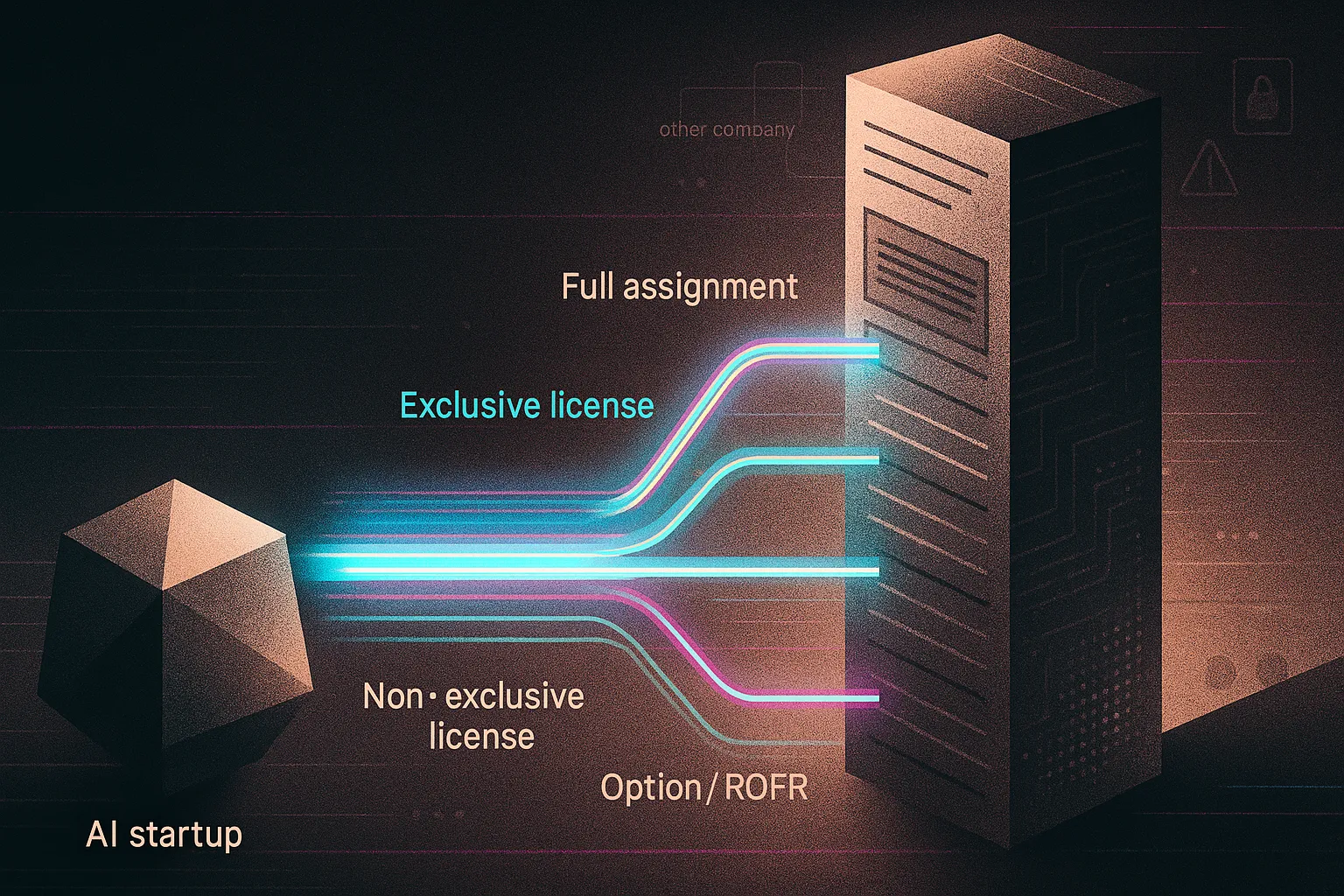
Before you “buy a patent,” get clear on what right you actually need. Most deals fit one of four structures:
- Full assignment: you purchase the patent and become the owner (maximum control, maximum diligence burden).
- Exclusive license: you get control in a defined field of use and/or territory, without owning the asset.
- Non-exclusive license: cheaper access, but weaker defensibility (others — including the seller — can also license/use).
- Option / ROFR: you pay to “hold the door” open to buy later, often useful when roadmap timing is uncertain.
Outright purchase tends to make sense when the patent is central to your product, needed to block a specific competitor, available in a distressed sale, or important for fundraising/M&A signaling. If you mainly need freedom-to-operate, a narrow license (or a design-around) can be the better trade.
Example: a startup buys a full assignment for six figures, then realizes a field-limited exclusive license would have covered its product at a fraction of the cost.
- Is this patent core — or a nice-to-have?
- Are you trying to block someone specific, or just reduce lawsuit risk?
- Do you need ownership for signaling, or just use rights?
- Do you have budget/bandwidth for diligence and potential enforcement?
Also pressure-test whether a different IP tool fits better: trademarks and copyrights protect different value than patents. See Promise Legal’s IP overview and the trademark class guide for startups.
Map Your Patent Acquisition Strategy to Your Business Plan
Don’t start with “what patents are for sale.” Start with your roadmap: what features, workflows, or model-adjacent methods create durable differentiation, and where would a patent actually change outcomes? Common acquisition goals include (1) protecting a specific product method or pipeline step, (2) assembling a licensing-ready portfolio, or (3) gaining negotiation leverage against incumbents (e.g., for cross-licenses or strategic partnerships).
Write down your target technology areas (2–5 keywords), desired jurisdictions (US-only vs. a global patent family), and an all-in budget range that includes purchase price, counsel fees, and ongoing maintenance/annuity costs.
Single-patent deals are simpler and cheaper to diligence, but portfolios can provide claim diversity (and negotiation leverage) at the cost of more complexity.
Example: a speech-recognition company maps its planned diarization and noise-robust decoding features to specific granted claims and pending continuations it wants to acquire.
- Patent thesis: the risk/revenue problem the patents should solve
- Focus: competitors/technologies you care about most
- Owner: who runs the process (legal, product, founder) and makes go/no-go calls
If you’re building (not just buying) IP in parallel, see Promise Legal’s startup IP overview at https://promise.legal/practices/ip.
Where to Find Patents for Sale and How the Market Works
Most startup patent deals come from a few repeatable channels:
- Direct outreach to inventors and small companies (or inbound offers after you publish your “patent thesis”).
- Brokers and marketplaces/auctions that package patents, run outreach, and manage bid processes.
- Distressed or bankruptcy asset sales where patents are sold to raise cash (often on a fast timeline).
- Non-core divestitures from larger companies (spin-outs, pruning programs, “clean-up” sales).
A patent broker typically sources candidates, prepares marketing materials, introduces buyers and sellers, and helps drive the process to signing. Fee structures vary, but commonly include an upfront fee plus a contingent “success fee” (some sources cite success fees up to ~35% depending on the deal). Brokers can be worth it when you need access to inventory, confidentiality, or a competitive process — but you’ll still need counsel to diligence and paper the transaction.
Many of the best patents are never publicly “listed.” Proactive identification (by assignee, inventors, or competitors) and thoughtful outreach is often how startups win.
Example: you identify a relevant patent family owned by a shuttered startup, then negotiate directly with the founders for an asset purchase.
If foreign counterparts matter, think in patent families (US + foreign filings) and plan for jurisdiction-by-jurisdiction assignment/recording. Related: Promise Legal’s IP practice overview at https://promise.legal/practices/ip.
Run a Rigorous Patent Due Diligence Process
In most acquisitions, the real risk isn’t the assignment form — it’s whether you’re buying clear, enforceable rights that actually matter to your product. Diligence should cover ownership, claim scope, status, and hidden deal “landmines.”
- Ownership / chain of title: confirm the seller is the true owner; review USPTO assignment records and the underlying assignments, employment/invention agreements, and any co-owner issues.
- Scope & strength: read the claims, prosecution history, cited prior art, continuations/divisionals, and any terminal disclaimers.
- Status & maintenance: granted vs. pending, deadlines, maintenance fees, and any lapse/reinstatement history.
- Encumbrances: security interests, liens, existing licenses, covenants not to sue, field restrictions, government rights (e.g., federally funded work), and JDAs.
- Disputes: litigation threats, past cases, PTAB proceedings, and foreign oppositions (if applicable).
- Coverage vs. FTO: does it cover what you do, and does it change your freedom-to-operate risk profile?
Patent Purchase Due Diligence Checklist
- Obtain and review all prior assignment agreements and invention assignment/employment documents.
- Confirm no undisclosed exclusive licenses in your target field/territory.
- Pull file histories for each asset; flag limiting statements and estoppels.
- Confirm maintenance fees are current and docket upcoming payments.
- Search for recorded security interests and request lien releases if needed.
- Confirm no outstanding government rights from federally funded research.
Example: a buyer pays for a “clean” patent, then discovers a perpetual, field-exclusive license already granted in the buyer’s core market — gutting the value.
Experienced patent counsel is essential for claim charting, prosecution-history risk, and a realistic enforceability assessment.
Related: If you’re also cleaning up internal inventorship/ownership, see Promise Legal’s PIIA template.
Understand Patent Valuation Basics Before You Negotiate
There’s no single “right” price for a patent. In practice, buyers triangulate using three lenses:
- Market / comparables: what similar assets in your space sold for, adjusted for claim quality and deal context (distressed vs. competitive auction).
- Income / benefit: realistic upside from licensing, incremental product revenue, or avoided costs (including leverage value in a dispute).
- Cost / strategic value: what it would cost (and how long it would take) to build around or recreate the position — and the strategic pressure it creates on competitors.
Price moves most with: remaining term and jurisdictions covered, claim breadth/enforceability, fit with your near-term roadmap, any existing royalties or licenses, and litigation history (a clean win can help; unresolved challenges can hurt).
Example: a narrowly drafted patent with three years left may be worth less than a younger patent family with continuations that can be tailored to your product — despite having “more patents” on the first deal.
Set a maximum walk-away range before you negotiate. If cash is tight, consider structures like equity, earn-outs, or running royalties rather than overextending on an upfront payment.
Negotiate the Deal: Key Terms, Protections, and Structures
Patent deals are often structured to balance cash, risk, and uncertainty. Common approaches include a lump-sum price, milestone payments (e.g., on grant or product launch), and hybrids like assignment + running royalty, revenue share, or a performance-based earn-out. You may also buy a broader IP package (multiple patents, applications, know-how files) rather than a single asset to improve coverage.
In the purchase agreement, focus negotiations on protections, not just price:
- Reps & warranties: true ownership; no conflicting grants; no undisclosed encumbrances; valid/in-force; no undisclosed litigation or PTAB challenges.
- Indemnities: for breaches and (where possible) pre-closing infringement/ownership claims.
- Covenants: seller cooperation (prosecution, enforcement, declarations), transfer of files, and obligation to assign related rights.
- Carve-outs: any retained license for seller’s legacy products should be narrow and explicit.
- Confidentiality / non-disparagement and limits on seller’s use of know-how.
Example: if diligence suggests a possible co-inventor, buyers often negotiate an escrow/holdback to cover the risk that a third party later claims co-ownership.
- Must-haves: ownership guarantee; “no hidden licenses”; lien release; file transfer; seller cooperation; clear scope of what’s conveyed (continuations/foreign counterparts if intended).
Paper the Assignment and Record It Properly
In a patent acquisition, the purchase agreement sets the business terms (price, reps/warranties, indemnities, covenants). The separate patent assignment is the short “conveyance” document you record with the USPTO to put the world on notice of the transfer.
A clean assignment should (1) identify each patent/application precisely (number, title, filing date), (2) convey the intended scope (e.g., continuations/divisionals, reissues, and foreign counterparts if included), and (3) be signed by the true legal owner(s) with authority (including all required co-owners or authorized officers).
Record promptly. Under 35 U.S.C. 261, an assignment can be void against a later bona fide purchaser/mortgagee without notice unless recorded within three months of execution (or before the later transfer). USPTO recordation is largely administrative and involves submitting the cover sheet and paying a recordation fee; foreign counterparts often require separate local filings.
Example: you close, delay recordation, and a later assignee records first — creating an avoidable ownership dispute.
Related templates and mechanics: Promise Legal's PIIA (inventions assignment) template.
Plan for Life After Closing: Integration, Enforcement, and Ongoing Costs
Buying the patent is only the start — its value shows up (or doesn’t) in how you operationalize it. Immediately after closing, get the assets into your IP management workflow: docket maintenance fees and key prosecution deadlines, store file histories and assignment documents, and ensure responsibility is clearly owned.
- Integrate & track: add each patent/application to your docketing system and confirm maintenance-fee calendars.
- Enable the business: align product and marketing on what the claims cover so the patent supports roadmap decisions and fundraising narratives.
- Set posture: decide whether you’ll be defensive-only, selectively license, pursue outbound enforcement, or use the asset for cross-licenses/patent pools.
- Budget reality: plan for maintenance fees, continuation filings (if any), and the possibility of enforcement or defense costs.
Example: a startup buys patents but never updates internal product specs or investor materials — so the assets provide little leverage despite the spend.
If you acquired foreign counterparts, coordinate renewals and any enforcement strategy jurisdiction-by-jurisdiction to avoid accidental lapses.
Actionable Next Steps
- Map your roadmap to patent needs: list the 3–5 product features/methods that drive differentiation and where owning claims would change your risk or leverage.
- Write a one-page “patent acquisition thesis”: goals (defensibility, licensing, leverage), target tech keywords, target competitors, and who internally owns decisions.
- Set an all-in budget: include purchase price, legal diligence, and ongoing maintenance/annuity costs.
- Build a target list: identify 5–10 candidate patents/patent families and gather public basics (assignee, status, term, prosecution history, recorded assignments).
- Prep your diligence and deal terms: use a checklist and a short list of required reps/warranties (ownership, no hidden licenses, no liens, cooperation).
- Choose a sourcing path: broker vs. direct outreach (or both), based on timeline, confidentiality, and deal size.
- Get counsel involved before you bid: a quick claim chart and chain-of-title review can prevent expensive mistakes.
If you’d like help scoping targets, running diligence, and negotiating/closing a US patent acquisition, contact Promise Legal via https://promise.legal/practices/ip.