
Introduction – Why Legal Data Science Matters Right Now
For fast-moving companies, legal work has become a bottleneck: slow contracts, scattered obligations, and reactive lawyering stall sales and fundraising. Data science gives legal teams the tools to move from reactive to strategic.

Introduction
For fast-moving companies, legal work has become a major bottleneck: slow contracts, scattered obligations, and reactive lawyering stall sales, delay launches, and hinder fundraising — while data science and AI reshape sales and product.
What we mean by “data science in legal practice”: using structured data, analytics, and ML/AI to measure, predict, and improve legal workflows and risk — extracting key fields, spotting compliance issues, and prioritizing lawyer review.
Who this guide is for: operations leaders and in-house or outsourced counsel for fast-growing companies.
What’s at stake: delayed deals, regulatory lapses, and avoidable legal spend that can cost money or derail growth. This is a practical guide. It offers concrete use cases, benefits, and a clear step‑by‑step plan — plus governance pointers (see our AI governance framework).
TL;DR
For busy execs and lean legal teams: legal data science makes legal work measurable and operational so you can speed deals, reduce spend, and surface risks earlier. Read this section for the quick priorities you can act on this quarter.
- Data science turns legal from a black box into a measurable, manageable process for contracts, compliance, and disputes.
- Even basic analytics (no advanced ML) can cut contract cycle times, reduce external legal spend, and improve negotiation leverage — see our AI case study for an example.
- High‑impact startup use cases: contract analytics, due‑diligence readiness, compliance monitoring, IP/competitive mapping, and legal knowledge search.
- The Recursive lawyer‑in‑the‑loop model is essential: use data/AI to prioritize, route, and draft; have lawyers supervise, approve, decide and iterate.
- Start small: pick one recurring workflow, instrument it with data, and build a simple, privacy‑aware stack.
- Apply a governance layer (access controls, quality checks, clear ownership) so experiments don’t become legal or privacy liabilities.
What “Data Science” Really Means in a Legal Context
Legal data science turns measurement into action for legal work.
- Descriptive: dashboards and reports (contract volume, cycle times, dispute rates).
- Diagnostic: root‑cause analysis (which counterparties or clauses cause delay or rework).
- Predictive: estimating likelihood/impact (renewal risk, dispute probability, compliance alerts).
- Prescriptive: recommending actions (route to a specific lawyer, suggest fallback clauses, flag high‑risk deals).
Common data sources you might already have: contract repos (DocuSign/CLM), ticketing/comms (Jira, Slack, email), CRM/finance (HubSpot, Stripe), and playbooks/templates (Notion, Google Drive).
Mini‑example: a SaaS startup used a simple contract log to show NDAs were blocking sales and automated a standard NDA. You don’t need a PhD or a full data team — start by structuring and measuring existing legal work. For advanced representations, see Promise Legal’s knowledge‑graphs post: What Makes Knowledge Graphs More Efficient Than a Traditional Database.
Key Legal Workflows Data Science Can Transform
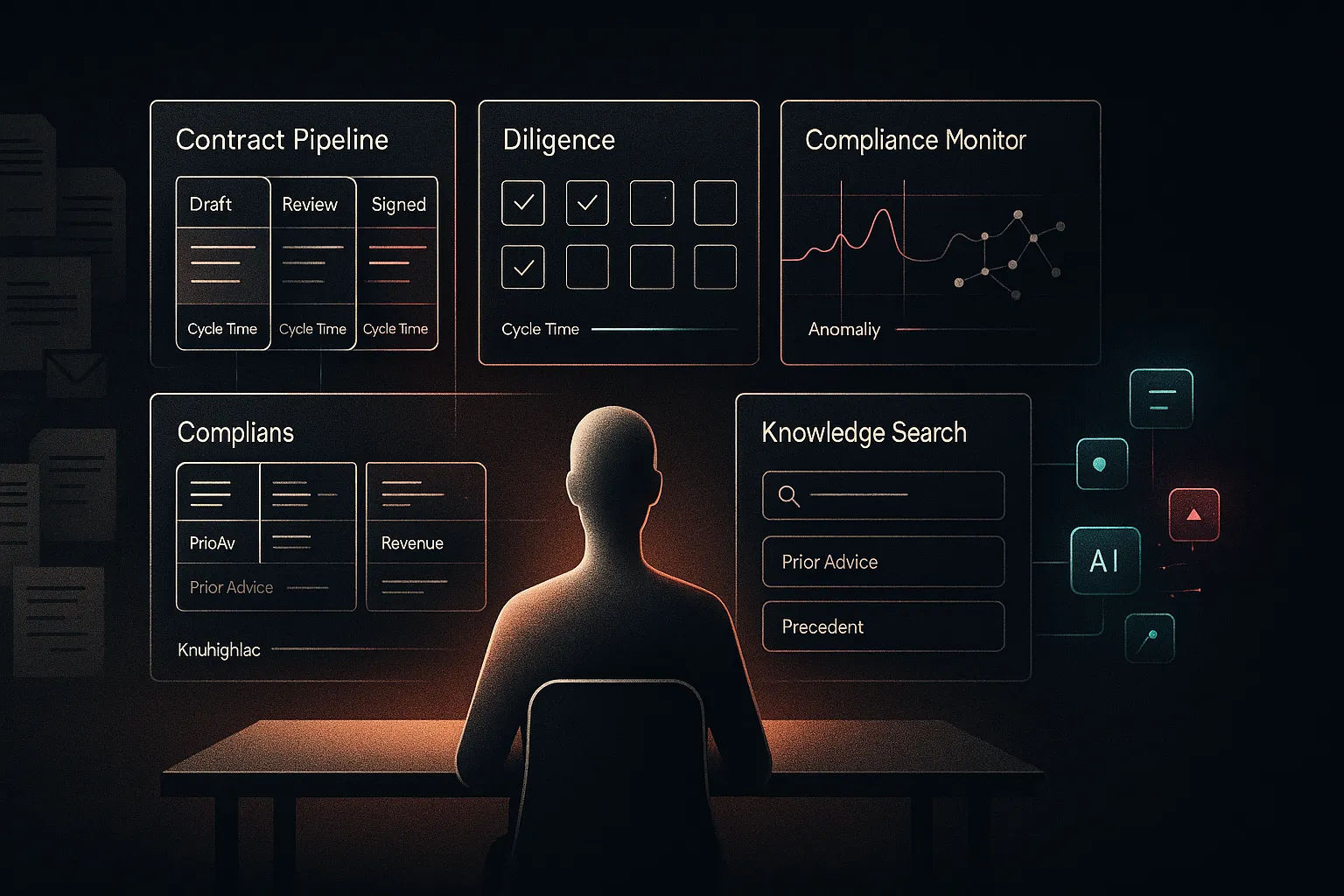
Five high‑impact legal workflows where simple analytics and AI deliver measurable gains.
1. Contract Lifecycle Analytics and Automation
Slow turnaround, inconsistent terms, and poor visibility are common; track stages and cycle times, use NLP to extract parties/term/auto‑renewal/pricing/data terms, and flag high‑risk clauses for focused review. Example: a B2B SaaS cut MSA cycle time from 21 to 7 days with field extraction, dashboards and standardized fallbacks. Maintain lawyer review (see the Recursive lawyer‑in‑the‑loop approach).
2. Fundraising and M&A Due Diligence Readiness
Tag contracts and corporate docs, track coverage gaps (DPAs, IP assignments), and use entity extraction to assemble quick risk views for smoother diligence.
3. Compliance and Regulatory Monitoring
Create rule‑based alerts from transactions and telemetry, link obligations to data flows, and surface anomalies (spikes in chargebacks, jurisdictional signups) for human review.
4. IP and Competitive Landscape Mapping
Mine patents, public code and app stores to map competitors, track filings, and spot white‑space for filing or licensing strategy.
5. Legal Knowledge Management and Search
Index templates, memos and past advice; use LLMs and simple graphs to surface precedent and speed repeat answers with lawyer verification.
Concrete Business Benefits for Startups and Growth Companies
Legal data science converts legal work into measurable outcomes that accelerate growth. Key benefits:
- Faster deal cycles: instrumenting contract stages and automating extraction shortens review time — speeding revenue recognition and sales velocity.
- Lower legal spend: triage and flag high‑risk matters so lawyers and outside counsel focus where they add value (see Promise Legal’s AI case study).
- Stronger negotiation leverage: historical and market analytics reveal common concessions and successful fallbacks.
- Reduced regulatory/contract risk: alerts and monitoring surface problems early, avoiding crisis lawyering.
- More founder focus: automate repetitive tasks so leadership focuses on product and growth.
Mini‑cases: SaaS used contract analytics to rescue a large renewal; a payments startup used anomaly detection to prevent suspicious activity and protect banking relationships.
In short: this is not just efficiency — it's a business advantage.
Designing a Practical Legal Data Strategy With Limited Resources
Most startups won’t hire a full legal‑data team; adopt a lightweight, ROI‑first approach.
- Start with one workflow: contracts or compliance deliver fastest wins.
- Reuse existing tools/data: CRM, e‑sign, ticketing, shared drives.
- Keep models simple: rules and transparent algorithms before complex ML.
- Lawyer‑in‑the‑loop: set clear thresholds for human review and ownership (learn more).
Minimal stack: organized storage/CLM; spreadsheets or BI dashboards; targeted contract analysis/LLM APIs; governance (access controls, logging, versioned templates).
Mini‑example: a 20‑person startup used a low‑code tool, a contract repo and a simple dashboard to route incoming customer contracts; as volume grows, add APIs, custom models or knowledge graphs.
Risk, Governance, and the Recursive Pattern by Promise Legal
AI and data science introduce real legal risks: confidentiality/privilege exposure when using external tools; biased or incomplete data that yields misleading risk scores; and over‑automation that misses compliance or contractual issues.
Lawyer‑in‑the‑loop: tools draft, summarize, classify and prioritize; lawyers approve, adjust, or reject. Set clear human‑review thresholds (e.g., contract value, novel IP, high‑risk jurisdictions).
- Data inventory: know what legal data you hold and where it lives.
- Access & logging: limit access and log AI queries touching sensitive data.
- Vendor diligence: verify where tools process/store data and vendor training/opt‑out policies — see our deeper dive on training/IP: Generative AI Training, Copyright & Fair Use.
- Quality checks: sample AI outputs regularly and assign ownership and escalation paths.
Example: a startup pushed auto‑summaries to sales, discovered errors, and moved to a lawyer‑in‑the‑loop review before distribution.
How to Get Started With Legal Data Science
A lean, step‑by‑step playbook for C-suite and small legal teams to get measurable wins quickly.
- Step 1 — Identify: pick one recurring legal bottleneck (e.g., customer contracts stuck in review, repeated privacy questions).
- Step 2 — Map: list systems (e‑sign, CRM, tickets, engineering logs, finance, shared drives) and which fields matter (value, jurisdiction, product, issue type).
- Step 3 — Metrics & dashboard: define 2–3 KPIs (contract cycle time; % with risky clauses; response time) and a simple exec‑friendly dashboard.
- Step 4 — Add targeted automation/AI: choose one high‑leverage action—field extraction, routing, or LLM summaries—and ensure every automation ties into a lawyer‑in‑the‑loop review (see guide).
- Step 5 — Govern & iterate: document owners, allowed tools, human‑review thresholds; run a 60–90 day pilot and measure time/money/risk improvements.
Hypothetical (health‑tech): audit BAAs, extract party/data‑scope fields into a sheet, automate population of a standard BAA, auto‑route exceptions to legal, then review results every 60 days.
Actionable Next Steps
Use this checklist to take concrete actions in the next 30–90 days.
- Audit one legal workflow (e.g., customer contracts): map steps, owners, and how long each step takes.
- Create a basic inventory of legal data sources and who can access them (CLM, e‑sign, CRM, tickets, drives).
- Define 2 metrics to track for the quarter (example: contract cycle time; % contracts with risky clauses) and surface them on a simple dashboard.
- Pilot a small automation or analytics tool with an explicit lawyer‑in‑the‑loop review; sample outputs and measure time saved (see our AI case study for examples).
- Draft a one‑page AI/legal governance note: permitted tools, data categories, access rules, and human‑review thresholds.
- Schedule a 60–90 day review with counsel or a specialist (e.g., Promise Legal) to stress‑test results and next steps.
Small, deliberate experiments — measured, governed, and lawyer‑vetted—prevent costly surprises and unlock scalable growth as your startup scales.
How Promise Legal can help: identify high‑value workflows, design Recursive workflows and governance, review/negotiation of legal‑tech vendor contracts, and act as an ongoing partner to scale your legal data strategy. To scope a lightweight legal data assessment or sanity‑check your AI/legal stack, visit Promise Legal.